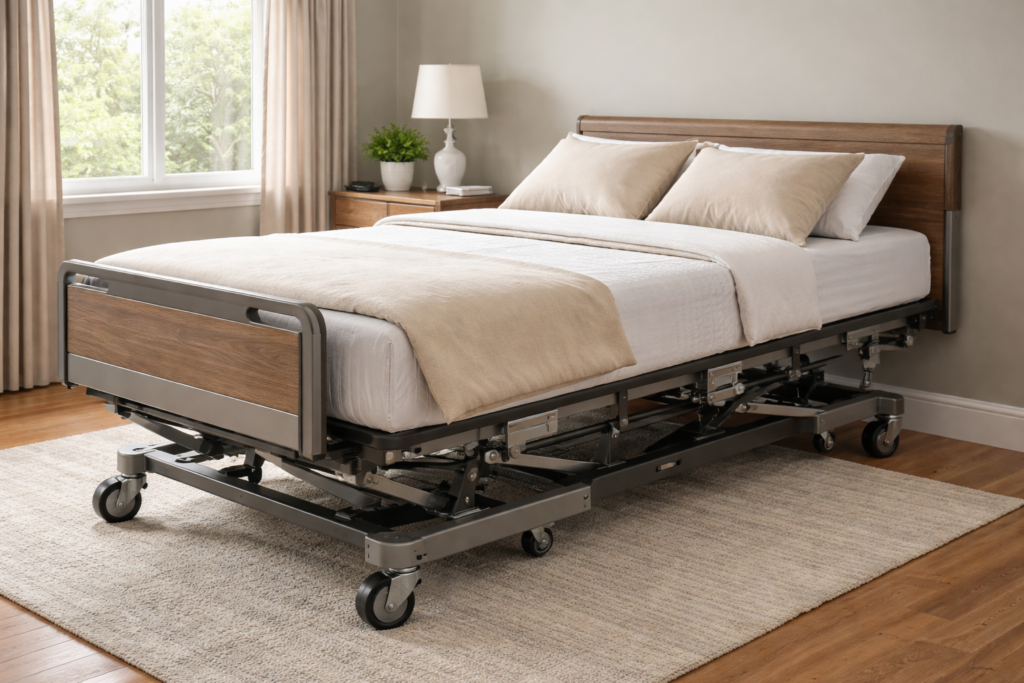
Home medical beds are designed to support people who need more stability, positioning control, or care assistance than a standard bed can provide. One of the most common questions families ask when considering a hospital-style bed for home use is how much weight the bed can safely support.
Understanding weight capacity is important because it affects safety, durability, mattress performance, and the long-term reliability of the bed’s motor and frame. While many home medical beds look similar at first glance, their weight limits can vary depending on the type of bed and how it is constructed.
Typical Weight Capacity of Home Medical Beds
Most standard home hospital beds are designed to support between 450 and 600 pounds (204–272 kg) of total weight capacity. This number usually includes:
-
The person using the bed
-
The mattress
-
Bedding and accessories
-
Any additional equipment placed on the bed
Manufacturers typically state a “safe working load” or “maximum patient weight.” These numbers are not always the same. The safe working load refers to the total weight the entire bed system can safely handle, while the patient weight limit refers only to the individual using the bed.
Because of this difference, the safe working load may be higher than the recommended patient weight.
Why Weight Capacity Matters
Weight capacity is not only about whether the bed can physically hold a person. It also affects how the bed performs over time.
A bed that is regularly used near or beyond its rated capacity may experience:
-
Increased strain on the frame
-
Reduced reliability of adjustment motors
-
Less stable positioning when the head or foot sections are raised
-
Faster wear on moving components
For someone who will be using the bed daily, especially for long periods of rest or care, choosing a bed that comfortably supports their weight helps ensure smoother operation and longer equipment life.
Bariatric Medical Beds for Higher Weight Needs
When additional support is required, bariatric home hospital beds are available. These beds are specifically engineered to handle higher weight capacities and provide greater stability.
Bariatric beds typically support:
-
600 to 1,000 pounds (272–454 kg) or more, depending on the model
These beds usually include:
-
Reinforced steel frames
-
Wider sleep surfaces
-
Stronger motors and lift mechanisms
-
Heavier-duty support platforms
They are often recommended when a standard hospital bed may not provide sufficient strength or comfort.
Mattress Weight Ratings Also Matter
The mattress used on a home medical bed also has a weight capacity. Even if the bed frame itself can support higher weight, the mattress must be appropriate for the user’s needs.
Pressure-relief mattresses, foam systems, and alternating air mattresses may all have different weight limits. When selecting a bed system, the mattress and bed frame should be considered together so they function safely as a single system.
Pressure care performance can be affected if the mattress is used beyond its intended weight range.
Considering Weight Distribution and Positioning
Weight capacity is also influenced by how the bed is used. Adjustable beds move the head, legs, and height of the frame, which shifts weight across different parts of the structure.
A well-designed medical bed distributes weight across the frame so that adjustments remain stable and smooth. Beds designed for higher capacities often include additional support rails or reinforced deck sections to maintain stability when the bed is raised or repositioned.
This is particularly important for people who frequently use upright sitting positions or require assistance with transfers.
When to Consider a Higher-Capacity Bed
Families sometimes choose a higher weight capacity bed even if it is not strictly required. This can provide additional stability and long-term reliability.
A higher-capacity bed may be helpful when:
-
The user is close to the upper limit of standard beds
-
The bed will be used frequently for positioning adjustments
-
Caregivers assist with transfers from the bed
-
Long-term use is expected
Having a comfortable safety margin can help the bed operate more smoothly over time.
Matching the Bed to the Person and Home Environment
Weight capacity is only one part of choosing the right medical bed for home use. Room layout, caregiver access, mattress type, and mobility needs also play an important role.
Understanding how these beds function in everyday home environments can make the decision process much clearer.
For a broader explanation of how these beds work and when they are typically recommended, see Home Hospital Beds Explained: When They’re Needed at Home.